
Fiverr - Freelance Service
FiverrBusiness
4.328.44K Reviews
- Version
- Varies With Device
- Installs
- 50.00M
- Age Rating
- Everyone
Screenshots

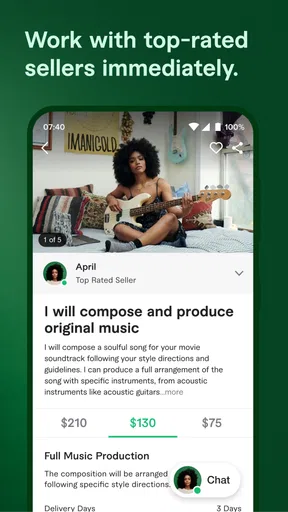

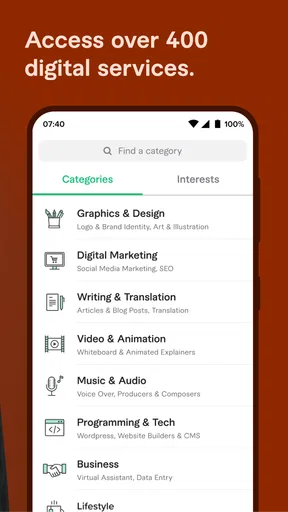

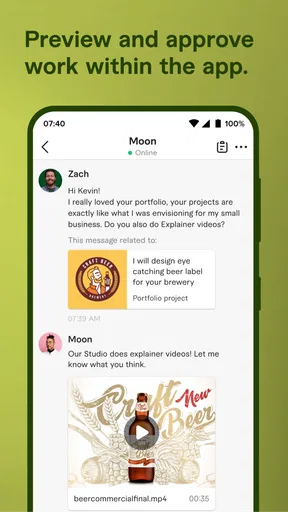

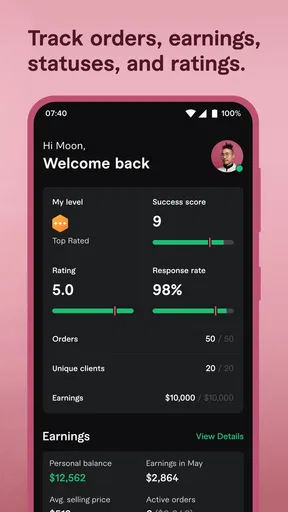
Our Review of Fiverr - Freelance Service
 Analysis by Appyee
When I first open Fiverr, the appeal is immediate: it turns the vague idea of “finding someone online to help” into a browsable marketplace of freelance services. I can search by the result I want rather than by a job title, compare different offers, read previous customer feedback, and start a conversation from my phone. That makes it useful for a surprisingly wide range of small business and personal projects.
It is a free business app from Fiverr, available to everyone, and its long presence on mobile helps explain why it feels more established than a newly launched gig marketplace. The app has an average rating of 4.3 from around 361,000 ratings, with more than 10 million installs. Those figures suggest a large, active audience, but they do not remove the need to judge each freelancer carefully. A busy marketplace can save time, yet it can also make choosing the right service more demanding.
What the first week feels like
During my first days with the app, I found the strongest part was discovery. Instead of preparing a formal job post and waiting for proposals, I could browse services that were already packaged around familiar needs: design work, writing, editing, marketing help, technical tasks, and many other forms of freelance assistance. That approach is particularly comfortable when I know roughly what I need but do not yet know how to describe it in professional terms.
The mobile format suits quick research. I can check examples while commuting, save promising options mentally or return to them later, and contact a seller without sitting at a desk. The app is not just a directory, though. The important decision happens inside each service page, where the wording, examples, delivery expectations, customer feedback, and seller communication give me clues about whether an offer is actually suitable.
My first useful habit was to search with several versions of the same request. Searching for “logo design,” “minimal logo,” and “brand identity” can expose very different groups of freelancers. The same applies to writing or video work. A broad search is good for learning what the marketplace offers, while a narrower search is better once I understand the vocabulary used by sellers. This is one of the app’s less obvious advantages: browsing teaches me how a project is commonly packaged before I spend money.
I also learned not to treat the first attractive thumbnail as the best choice. Strong visuals can draw attention, but the real question is whether the seller’s examples resemble the style and complexity of my own project. A portfolio full of impressive work may still be a poor match if the seller normally handles a different type of client. I get better results when I compare several relevant examples instead of judging the service from its cover image.
For a realistic everyday scenario, imagine that I run a small online shop and need a short promotional video for a seasonal product. I can use the app to inspect video specialists, compare the tone of their previous work, ask whether they can work with my existing footage, and clarify what I must provide. That is more practical than hiring someone solely because the service looks inexpensive. The mobile conversation is especially useful when I need to resolve a detail before committing.
The first-week experience is therefore strongest for defined, limited projects. If I need a single illustration, a short translation, an audio edit, or help polishing a presentation, the marketplace structure makes the next step clear. I can browse, compare, ask questions, and decide. It is less comfortable when I only have a broad ambition such as “improve my business,” because the app offers many directions without automatically turning that ambition into a sensible plan.
How to choose without wasting the first order
I recommend writing a compact project brief before contacting anyone. I include the purpose, audience, dimensions or format, examples I like, deadlines that genuinely matter, and what files I can provide. This prevents a common mistake: selecting a service first and only then discovering that the seller needs information I have not prepared. A clear brief also makes conversations more comparable because I am asking different sellers to respond to the same basic requirement.
Another useful approach is to separate “cheap” from “low risk.” A low-cost offer may be appropriate for a small experiment, but it may also involve a narrower scope than I initially assume. I read exactly what is included, then ask about the parts that could affect the finished result. If I need several concepts, source files, revisions, or a particular technical format, I confirm that before ordering rather than hoping it is understood.
The app works well for people who enjoy making decisions from examples. It is not as satisfying for someone who wants a single vetted professional to guide the entire project from strategy through delivery. Traditional agencies or a personal referral may be better when trust, continuity, and close collaboration matter more than marketplace choice.
What remains valuable after the novelty fades
After the initial browsing excitement, the app’s lasting value depends on whether I have recurring freelance needs. For occasional users, it can remain a convenient place to solve an isolated problem. For a small business, creator, or independent professional, it can become a working tool for filling skill gaps without adding a permanent employee to every task.
The most durable use is not ordering random services whenever an idea appears. It is building a repeatable workflow. I might use one specialist for presentation graphics, another for proofreading, and another for short-form video. Over time, I learn which types of briefs produce good results and which tasks are better handled elsewhere. That accumulated knowledge is more valuable than the novelty of browsing thousands of listings.
I find the service particularly practical when the work is modular. A project can be divided into a thumbnail, a caption set, a voice recording, an edited clip, or a small design asset. Each piece has a clear output, which makes it easier to explain and review. The marketplace is less naturally suited to work that changes direction every day, depends on constant meetings, or requires one person to understand a complicated organization from the inside.
One of my favorite long-term tactics is to use a small initial task as a compatibility check. Rather than assigning a large project immediately, I can begin with a limited deliverable that tests communication, interpretation, timing, and attention to detail. This does not guarantee a perfect relationship, but it gives me more useful evidence than a polished profile alone. If the collaboration works, future briefs become faster because I already understand the seller’s style.
That approach also answers an important question: can the app support repeat work, or is it only for one-off purchases? In my experience, it can support repeat work when I take responsibility for documenting what worked. I keep a simple record of the preferred format, tone, dimensions, file types, and feedback for each successful project. The app provides access to freelancers, but I create the continuity. Without that personal organization, every new order can feel like starting from zero.
Compared with asking for recommendations in a social network, Fiverr offers more immediate choice and a more structured way to inspect services. Compared with a traditional agency, it usually feels more flexible for small assignments, but I have to perform more of the screening and project management myself. Compared with hiring a local freelancer directly, it can be easier to start, while face-to-face context and long-term personal trust may be stronger outside the marketplace.
Where recurring value is strongest
The app earns a regular place on my phone when I use it as a sourcing and comparison tool, not as an impulse-shopping feed. I return when I have a clearly defined task, when I need to explore how other professionals approach it, or when an existing workflow needs an extra pair of hands. That makes its value practical rather than purely entertaining.
It is also useful for learning the boundaries of my own skills. Before hiring someone, I can browse how specialists describe an assignment and see what a finished result might involve. That helps me decide whether I need execution, advice, or both. The distinction matters: paying for a polished output is different from paying for someone to help me choose the right direction.
For students, early-stage creators, and small teams, this flexibility can be meaningful. They may not need a full-time designer, editor, translator, or marketing specialist. They may only need a specific contribution at a particular moment. The app is strongest when the user can define that contribution, supply the necessary material, and evaluate the result with reasonable objectivity.
The maintenance burden behind the convenience
The app itself is easy to keep available because it is free to download and use as a business marketplace. The greater maintenance burden is project management. I need to maintain clear briefs, answer questions, check files, provide feedback, and make sure the final result matches the original purpose. The phone removes some friction from communication, but it does not remove the work of being a good client.
Notifications and messages can become distracting when I browse without a real project. I prefer to open the app with a specific question: which service type fits this task, what should I ask a seller, or which examples are closest to my intended result? That small discipline keeps the marketplace from becoming a source of endless comparison.
There is also maintenance in keeping expectations realistic. A service listing may use familiar language, but two sellers can interpret the same request differently. I therefore confirm the deliverable in plain terms before moving forward. For design, that might mean the number of concepts and the final file format. For writing, it might mean the intended audience, tone, and length. For technical work, it might mean exactly what will be changed and what remains outside the assignment.
The app is not a substitute for backups, version control, or careful file organization. I keep my original materials separate, label incoming files clearly, and avoid allowing a single freelance delivery to become the only copy of important business content. This is a simple habit, but it matters more than the convenience of ordering from a phone.
Users may also wonder whether the app is appropriate for sensitive or high-stakes work. I would be cautious. A marketplace can help locate a capable specialist, but confidential business information, legal documents, personal data, and security-sensitive material deserve extra scrutiny. I only share what is necessary for the task and consider whether the project should instead stay with a professional bound by a closer, more suitable relationship.
Why fatigue appears over time
The main source of fatigue is choice overload. A large marketplace sounds helpful, but comparing many similar offers can consume the time I hoped to save. Search results may introduce attractive possibilities that are not relevant to my actual goal, and it is easy to confuse a polished presentation with dependable execution.
Another tiring point is translating a personal expectation into an objective brief. I may know that a design feels “too busy” or that a video needs to feel “more energetic,” but those impressions are not automatically useful instructions. The better I become at giving examples and explaining the intended audience, the less back-and-forth I need. Still, that learning curve is a real cost for inexperienced users.
Communication can also be slower than working with someone beside me, especially when a project needs many small decisions. A local colleague may understand context from a short conversation, while a remote seller may require written explanation and reference material. For a task with frequent changes, the convenience of the marketplace can disappear under revisions and clarification.
Quality consistency is another reason I would not use the app blindly for every part of a brand. Different freelancers may produce work with different voices, visual standards, or technical assumptions. If I want a unified identity, I either keep the work with one reliable collaborator or create detailed guidelines before distributing tasks. Otherwise, the marketplace solves individual assignments while creating a larger consistency problem.
I would also skip it when the cost of a misunderstanding is unusually high. A quick social graphic is one thing; a critical legal, medical, financial, or security decision is another. Fiverr can connect me with people offering specialized services, but the presence of a specialist listing does not transfer responsibility for verifying expertise or suitability. In those situations, a regulated professional or established provider may be the safer choice.
Who should keep it installed
I would recommend the app to people who need flexible access to freelance help and are willing to participate in the selection process. Small businesses, independent creators, online sellers, and busy professionals can all benefit when their tasks are specific enough to describe and evaluate. It is especially useful when the alternative is delaying a project because a small missing skill is blocking progress.
I would be more hesitant to recommend it to someone who dislikes comparing options, expects a freelancer to infer every requirement, or wants unlimited collaboration inside one fixed relationship. That person may be happier with a trusted local contact, a specialist agency, or a professional network where recommendations carry more personal context.
The age rating of Everyone makes the app broadly accessible, but suitability still depends on the work being commissioned and the judgment of the user. Younger users in particular should involve a responsible adult when handling payments, personal information, or unfamiliar professional relationships. The marketplace may be open to a wide audience, but responsible buying habits remain important.
My practical advice is to start with a modest, clearly bounded task, prepare the brief before browsing, compare relevant examples rather than popularity alone, and treat communication as part of the evaluation. If the first experience is good, save the workflow and build a small circle of dependable contacts. That is how the app moves from novelty to a useful business habit.
My long-term verdict
Fiverr earns lasting space on my phone when I treat it as a flexible tool for defined freelance work. Its free access, broad marketplace, and mobile conversations make it easy to investigate help at the moment I need it. The developer, Fiverr, has built an app that is most convincing not when I browse aimlessly, but when I arrive with a real task and enough information to judge the possible solutions.
Its weaknesses are inseparable from its strengths. Choice can become fatigue, convenience can hide project-management work, and a low barrier to ordering does not guarantee a good match. I still have to screen carefully, describe the result, protect sensitive material, and decide whether marketplace flexibility is more valuable than a deeper ongoing relationship.
With more than 28,000 reviews represented in its store presence and a long-running place in the business-app landscape, it feels like a service designed for repeated practical use rather than a short-lived experiment. I would not make it the answer to every professional need, but I would keep it installed for those moments when a clearly defined project needs a specialist and I want to explore several possible routes before committing.
My final recommendation is simple: use it deliberately, begin small, and judge the result by whether it saves time after the first order, not by how exciting the marketplace feels on day one. For recurring, well-scoped freelance tasks, that test is often passed. For complex, sensitive, or highly collaborative work, another option may serve you better.
Privacy and Permissions
See what permissions an app requests and how it handles your data.
- Phone
- read phone status and identity
- Photos/Media/Files
- read the contents of your USB storage, modify or delete the contents of your USB storage
- Storage
- read the contents of your USB storage, modify or delete the contents of your USB storage
- Camera
- take pictures and videos
- Wi-Fi connection information
- view Wi-Fi connections
- Device ID & call information
- read phone status and identity
- Other
- view network connections, full network access, run at startup, use accounts on the device, control vibration, prevent device from sleeping, Google Play license check, read Google service configuration
Verdict
Strengths of Fiverr - Freelance Service
- Wide range of freelance services for personal and business needs.
- Easy search filters help narrow results by budget, delivery time, and category.
- Seller portfolios and ratings make comparing providers more convenient.
- Built-in messaging supports clear communication before placing an order.
- Order tracking and delivery tools keep projects organized in one place.
Limitations of Fiverr - Freelance Service
- Service quality can vary considerably between freelancers.
- Popular sellers may charge extra for faster delivery or revisions.
- Platform fees can increase the final cost for buyers.
- Some listings use generic descriptions that require careful clarification.
- Resolving disputes may take time when expectations are unclear.
Similar Picks in This Category
View All
LinkedIn: Community & Network
LinkedIn3.8

Zoom Workplace
zoom.com4.1

Microsoft Teams
Microsoft Corporation4.6

Meta Business Suite
Meta Platforms, Inc.4.6

Webex Meetings
Cisco Systems, Inc.4.5

TeamViewer Remote Control
TeamViewer4.4
Frequently Asked Questions
What is Fiverr, and what services can I find on the app?
Fiverr is a freelance marketplace where users can hire independent professionals or offer their own services. After exploring the app, you can find freelancers for graphic design, writing, translation, video editing, programming, digital marketing, music, business consulting, and many other categories. Services are usually presented as fixed-price packages, although custom offers may also be available for more complex projects.
Is Fiverr safe to use for hiring freelancers or selling services?
Fiverr includes several features designed to make transactions safer, such as in-app messaging, order requirements, payment processing, delivery tracking, and an order review system. However, users should still check a freelancer’s ratings, reviews, portfolio, response time, and cancellation history before placing an order. Keeping communication and payments inside Fiverr is important because off-platform arrangements may not receive the same protection.
How much does Fiverr cost, and are there additional fees?
The price depends on the freelancer, service category, package, and project requirements. Buyers may also see a service fee added during checkout, while taxes or other charges can apply depending on location and current Fiverr policies. Sellers typically receive the amount remaining after Fiverr’s commission. Before confirming an order, carefully review the complete checkout total and the included revisions or deliverables.
Can I get a refund if I am unhappy with a Fiverr order?
Fiverr orders are generally expected to follow the agreed requirements, but problems can occur if the delivery is late, incomplete, or significantly different from the description. If you are dissatisfied, you can first communicate with the freelancer and use the platform’s resolution options. Refund eligibility is not automatic and may depend on the circumstances, order status, revisions, and Fiverr’s current policies, so reading the terms is recommended.
Can beginners make money on Fiverr, and how does selling work?
Beginners can create a Fiverr seller profile and publish service listings, commonly known as gigs, describing what they offer, their prices, delivery times, and included revisions. Success usually requires a clear niche, professional samples, competitive pricing, fast communication, and reliable delivery. New sellers should also understand that visibility and orders are not guaranteed, and Fiverr may apply commissions or waiting periods before earnings become available.
